


Vietnamese dragon fruit exporters are expected to have another difficult year as more countries grow the fruit and make the international market increasingly competitive.

The director of a dragon fruit purchasing business in Binh Thuan also said that now his company can produce a number of times a day, sometimes only a few rows of containers, while previously the number was up to a percentage.
Vietnamese dragon fruit has now been exported to more than 15 countries and territories. In addition to market communication systems such as China, Thailand, Malaysia, Vietnamese dragon fruit also penetrated into difficult markets such as the US, Japan, Korea, New Zealand, and Australia. Previously, Vietnamese dragon fruit used to hold a unique position in the international market when using 80-90% of transactions.
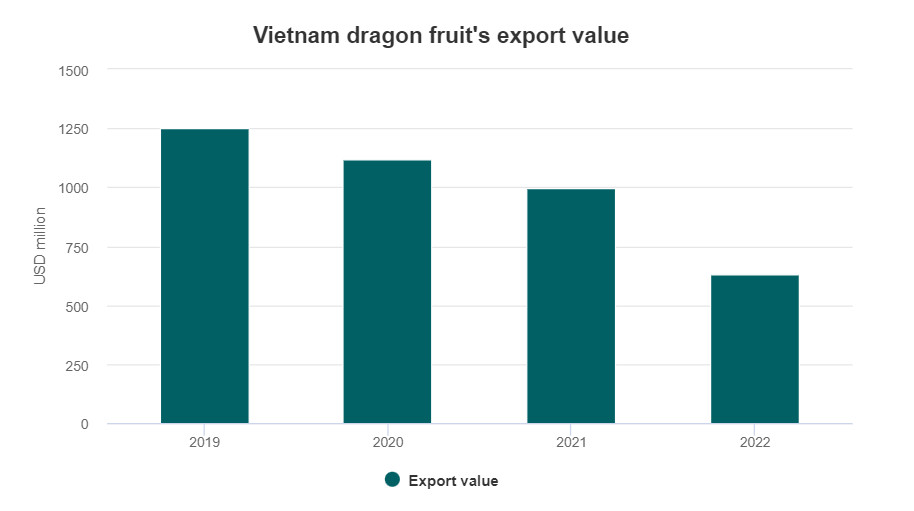
However, statistics of the General Customs found that from 2019 to now, Vietnam’s dragon fruit export turnover has continuously decreased sharply. In particular, in 2021 and 2022, dragon fruit has fallen out of the top USD exchange rate export products of Vietnam. In five codes, the export turnover of this item reached just over USD 632 million, down nearly 39% compared to 2021 and down over 49% compared to the peak of 2019.
In the first two months of this year, export activities were more favorable, but statistics from the Import-Export Department – Ministry of Industry and Trade showed that dragon fruit exports reached nearly US$106 million, down 26.9% over the same period in 2022.
Explaining the sharp drop in export output, business representatives said that many countries participate in dragon fruit production, making the market increasingly competitive.
According to Mr. Nguyen Dinh Tung, General Director of Vina T&T Import-Export Company, China (the main market of Vietnamese dragon fruit) has opened the market, but now the country is actively growing dragon fruit, so the need to import limited than before. to previous years.
Specifically, at the end of February, China announced an output of 1.6 million tons of dragon fruit/year, 200,000 tons higher than Vietnam, rising to the world’s leading position in output. This farming productivity almost meets the consumption demand of about 2 million tons/year of the whole country.
India has also successfully grown this fruit. Recently, the Government of India has decided to build a farming roadmap to 50,000 hectares in the next 5 years, from the current 3,000 hectares.
In addition, Mexico has also cultivated dragon fruit, limiting Vietnam’s export market share to the US and Canada. Mr. Tung cited that in 2010, Vietnam exported dragon fruit to the US very well. Since 2019, when Mexico has been able to cultivate this variety, it has taken market share in the US and Canada, making it impossible for Vietnam to export white dragon fruit here (except for a few types of red flesh because the country has not been able to cultivate it). .
Enterprises also forecast that dragon fruit export volume will decrease this year. In the following years, the price of this item is also difficult to increase if Indian and Chinese goods are produced in the market with large output. The risk of goods from your country will be exported back to Vietnam when their prices are cheaper.
Currently, it is difficult for Vietnamese vegetables and fruits to come to India because this country has high taxes. However, Vietnam has a trade deficit of many fruit and vegetable products from India.
In the context of China and India “running a race” on dragon fruit output, according to Dang Phuc Nguyen, General Secretary of the Vietnam Fruit and Vegetable Association (Vinafruit), Vietnamese farmers and businesses need to re-evaluate the market. to exploit its advantages. In addition to focusing on product quality and design, farmers need to choose the right time to cultivate.
Instead of planting massively as before, it is necessary to increase off-season goods, a time when countries like India and China cannot do it. The long Chinese winter makes it difficult to grow dragon fruit. Therefore, Vietnamese farmers should increase the planting of dragon fruit for harvest at the beginning and end of the year because at this time the goods from your country are very few, even difficult to bear fruit.
Sharing the same view, Mr. Tung said that Vietnam needs to step up the harvest before or after the country’s goods run out of season. To do so, local authorities must inform farmers so that they can prepare and cultivate properly. “We should also promote the cultivation of red flesh dragon fruit because this product is difficult to grow in other countries,” said Mr. Tung.
In addition, to avoid dependence on markets, according to Mr. Tung, businesses need to focus on deep processing.
Sources: vnexpress.net